



Remote Monitoring for Critical Connections with Live Bolt Data
Remote monitoring is no longer a futuristic dream. It is becoming a practical answer to a very simple constraint of not enough people, hard-to-reach assets, and safety rules that make every on-site visit an expensive nightmare. At the same time, critical connections in energy, infrastructure and industry are expected to run far longer, with fewer interruptions and less risk.
In that reality, relying only on periodic torque checks and visual inspections creates a major gap. Remote inspections support less travel to sites, but they still depend on what someone can see at a given moment in time. The real question for reliability managers is different: how can you keep an eye on what actually matters, continuously, without sending someone in the field every time you want to know if everything is okay?
This article looks at remote monitoring from the perspective of bolted joints and other critical connections. It explains what remote monitoring actually means in an industrial setting, how live data changes the balance between manual and continuous monitoring, which signals matter for clamp force and structural load, and how long-term monitoring fits into planning and decision making.
What is Remote Monitoring?
In many organisations, remote monitoring still sounds like a generic promise. In practice, it means placing sensors where forces, movements or temperatures say something real about risk, connecting them so they send data without someone being on site, and turning that live data into maintenance and integrity decisions instead of just another graph.
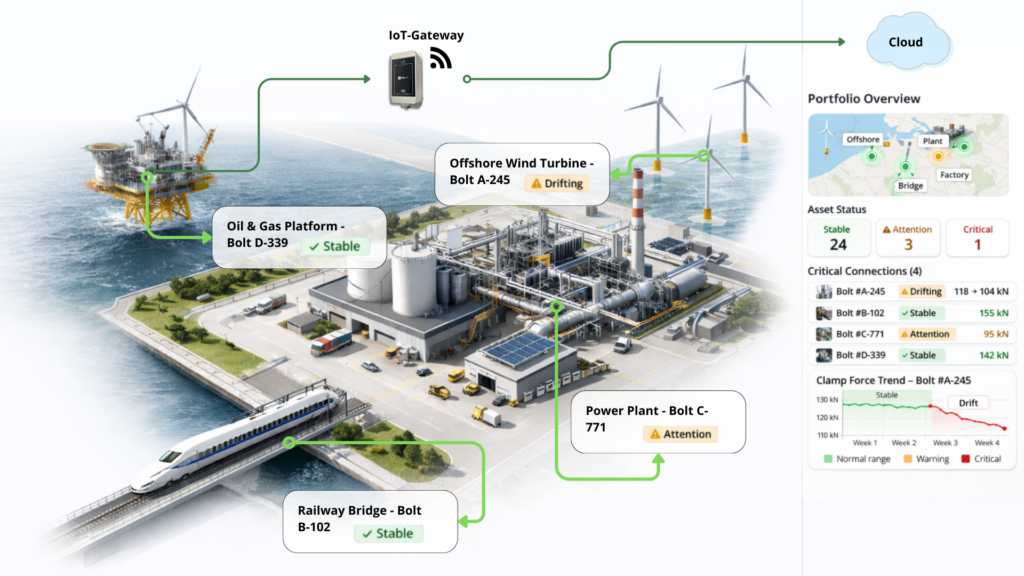
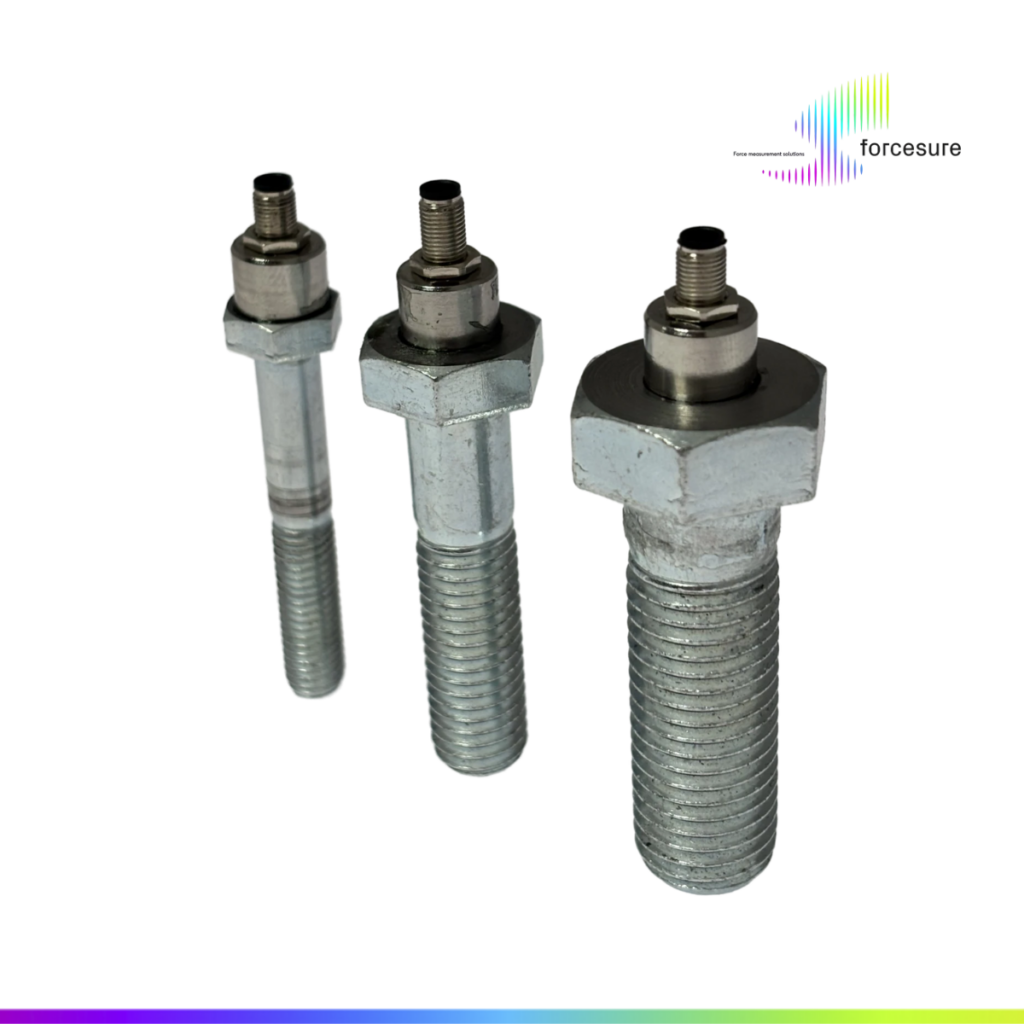
For bolted joints and structural connections, that sensor is often a force sensor in the load path. A smart bolt like Databolt measures tension inside the fastener and streams it via a wired or wireless link to a small gateway; from there, cloud-connected sensors forward the data to a secure platform where clamp force and structural load behaviour over time become visible, not just the installation moment. Remote monitoring does not replace onsite monitoring and inspections; it filters where and when they are needed most. Continuous monitoring of a few critical connections shows which assets stay stable and which start to drift, so teams can decide where they really need a technician, a closer inspection, or a deeper diagnostic check.
Manual Inspections vs Live Data: Differences in risk control
Manual inspections are familiar. A team goes into the field, walks the line, checks connections and reports what they see. Remote inspections through video or photos add a layer of convenience, but they still capture moments, not behaviour. Both approaches are snapshots, influenced by access, visibility and human judgement. They are valuable, but they leave the period between visits largely invisible.
Remote monitoring offers a different kind of control. With live data from critical connections, you see how key parameters move during storms, start-ups, shutdowns and unusual operating modes. You can tell whether a joint simply experiences normal variation or whether it shows a trend that points to loss of preload, local overload or changing support conditions. That difference is crucial for assets where a small change in clamp force can grow into a larger structural issue if it goes unnoticed.
The combination is often the strongest option. Remote monitoring highlights where risk is changing; onsite monitoring and inspections then focus on those locations. Instead of repeating the same route at fixed intervals, teams target follow-up work where live data suggests that something is no longer behaving as designed. Over time, this shift reduces blind spots and makes risk control less dependent on being in the right place at the right moment.
What to Monitor in Critical Connections: clamp force, trends and thresholds
Remote monitoring becomes effective when you choose signals that reflect the real state of a connection. For bolted joints, clamp force is the central one. Measuring tension in the bolt itself shows how structural load is shared between fasteners and whether that load stays within the expected window during operation.
Alongside clamp force, long term monitoring of vibration or dynamic strain can reveal how loads change under different operating conditions. In rotating machinery, vibration monitoring can show how a joint responds to imbalance or resonance. In bridges or towers, changes in dynamic response can hint at altered boundary conditions or stiffness. What matters is not a single value, but the way these signals evolve over time.
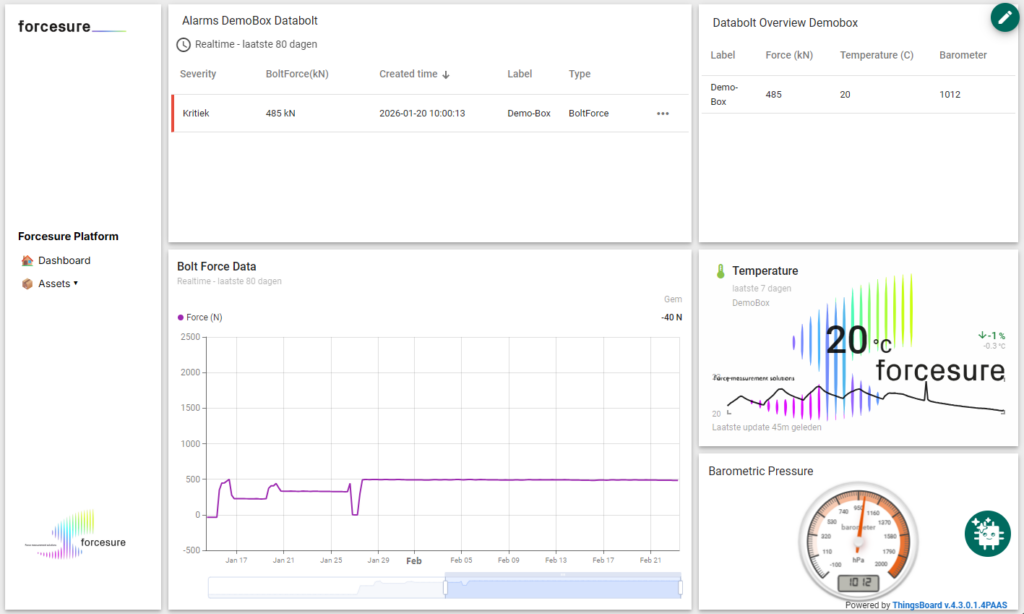
To turn raw load data into information, you need simple thresholds and trend rules. A baseline is established after installation or after a known good state. From there, remote monitoring tracks whether clamp force and vibration stay within agreed bands, drift slowly or change abruptly. Stable trends support confidence in the connection. Deviations trigger questions: is this a one-off event, a change in structural load, or the beginning of a problem that needs planning.
How Long Term Monitoring Changes Maintenance Planning
The real strength of remote monitoring shows up over months and years. With long term monitoring in place, you can see seasonal patterns, operational cycles and rare events all in the same data set. You learn how a set of joints behaves through winter and summer, through different loading regimes and through changes in process or traffic. That context is difficult to obtain with only periodic visits.
For maintenance planning, this continuous monitoring creates several options. Joints that show flat, predictable behaviour can move to longer inspection intervals, freeing capacity without increasing risk. Connections that show slow, manageable changes in clamp force can be scheduled into planned outages rather than causing unplanned downtime. Only the joints that show irregular patterns or sudden shifts need urgent attention.
Over time, this approach changes the shape of the work. Instead of planning based purely on asset type or age, planners can use live data to prioritise. Work orders reference not only the location of a joint, but also the trend that triggered the decision: a steady loss of preload, load peaks beyond design expectations or unusual vibration at specific times. Long term monitoring then becomes part of maintenance analytics, feeding back into design assumptions and integrity models rather than remaining an isolated dashboard.
Implementing Remote Monitoring
The idea of remote monitoring can feel large when you look at an entire portfolio of assets. In practice, most successful programmes start small. One or two critical connections are instrumented with smart bolts and connected to a simple data path. The aim of that first step is not to monitor everything, but to see how live data behaves in your specific environment and how it can support decisions.
A practical model is to begin with a pilot that combines several elements: a few instrumented joints, a basic visualisation of live data, and a clear list of questions you want answered. Does this connection carry more load than expected? Do we see evidence of settlement? How often does this joint experience peak loading? The pilot then runs for a defined period, long enough to capture different operating conditions and one or two unusual events.
From there, scaling decisions become grounded. If remote monitoring reveals useful patterns and leads to better work orders or fewer urgent call-outs, it makes sense to extend the setup to more joints or assets. If the benefit stays limited, the design of the monitoring system or the placement of sensors can be adjusted. This way, remote monitoring grows as a capacity strategy, not as a gadget deployment. It builds confidence step by step, with each expansion tied to outcomes rather than assumptions.
FAQ: remote monitoring for critical connections
What is remote monitoring in this context?
In this context, remote monitoring means collecting data from sensors on critical connections without having to be physically present at the asset. Smart bolts, strain or vibration sensors measure how clamp force and structural load behave during real operation. Those measurements are transmitted through wired links or cloud connected sensors to a central platform. Teams can then review the condition of joints, compare trends and set thresholds from the office or control room instead of relying only on field visits.
What is live data in maintenance?
Live data in maintenance refers to measurements that are updated frequently enough to reflect what is happening now, not just what happened at the last inspection. For bolted joints, this could mean tension values every few seconds, minutes or hours, depending on the application. Live data makes it possible to see how forces respond to events such as start-ups, storms or load changes, and to use those responses as part of condition assessments and planning.
How do you start with continuous monitoring without overcomplicating things?
A good starting point for continuous monitoring is to select one critical joint or small group of joints where access is difficult or where failure would have a clear impact. Instrument those connections with suitable sensors, ensure a reliable data path, and agree in advance what you want to learn from the monitoring. Keep the first setup simple, with a limited number of thresholds and a clear plan for what to do if they are exceeded. Once you have seen how the system behaves and how it fits into existing maintenance workflows, you can decide how to extend it to more assets.
From Idea to Pilot
Remote monitoring for critical connections is not about replacing people with screens. It is about giving maintenance and integrity teams a clearer view of how joints behave between visits, so that their expertise is used where it matters most. When remote monitoring is tied to clamp force, structural load and simple thresholds, it becomes a practical extension of existing work rather than a separate project.
If you want to explore what this could look like in your assets, a remote demo is often the most efficient first step. Reviewing real examples of live bolt data, discussing threshold logic and scoping a small pilot makes it easier to see how remote monitoring can support your own condition monitoring and asset integrity strategies. From there, the path from manual inspections to live data becomes less abstract and more about specific connections, specific questions and measurable outcomes.
Leave a Reply