


Upcomming Solution: Handle Integrated Force Sensor
FORCESURE
Forcesure is currently developing a dedicated force sensor to integrate directly into the handlebars or grips of mobility aids, electric hospital beds, carts, and other human-operated equipment.
How It Works
The Handlebar Force Sensor detects how much physical effort is being applied, turning manual movement into measurable data that can be used for control, safety, or support automation.
This sensor is ideal for any situation where human input and transported weight collaborate. It has broad applicability potential for mobility, ergonomics, and patient care.
Key Functions
- Effort-based input recognition – detects pushing or pulling forces
- Real-time signal output – Can trigger assistance or control behaviour without any time lag
- Discreet handle integration – Compact and ergonomic
- Robust design – Resistant to repeated use, cleaning agents, and hospital conditions
- Scalability – Fits a variety of handle shapes, including retrofitting
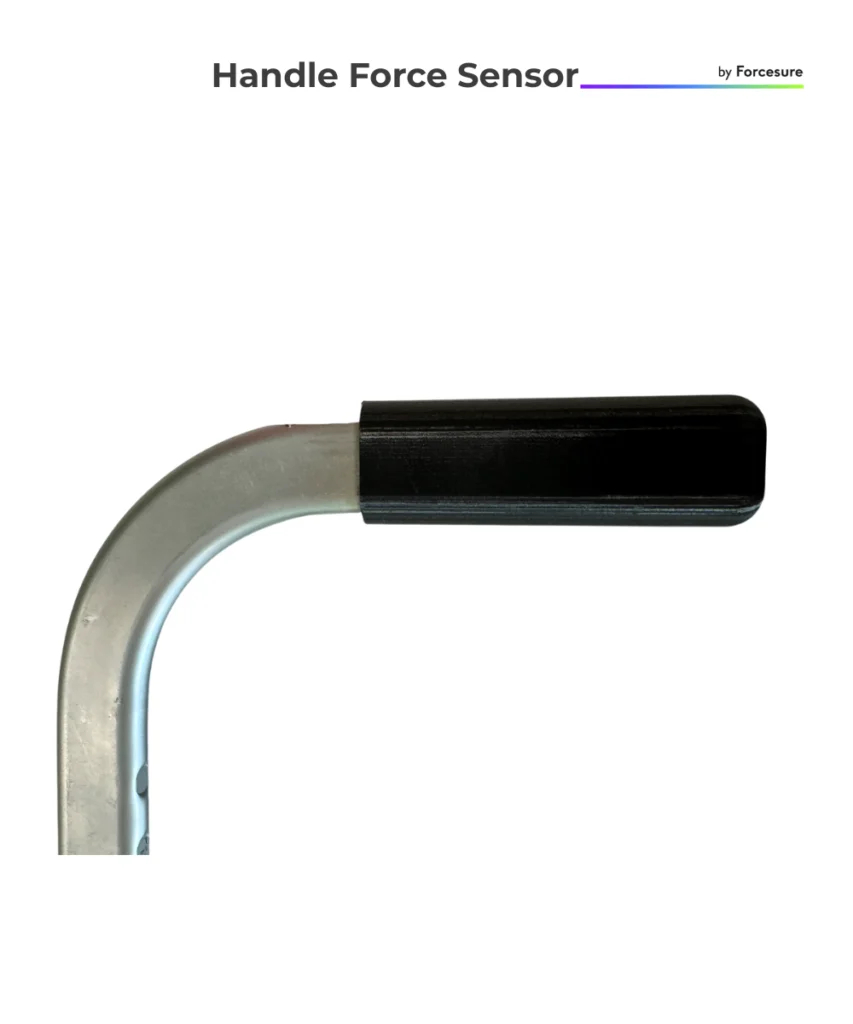
Sensor Integration
The Handle Force Sensor is embedded
with a force sensing element within
the grip structure. It allows for
real-time detection of pulling or pushing forces.
Protective Casing
The sensor is protected by a durable,
weather-resistant housing, it is protected
against dust, moisture, and
mechanical impact.
Modular Integration
The sensor is designed to be flexible
into various handlebar configurations.
Ideal for a variety of applications
- Wheelchairs to assist based on push intensity
- Hospital beds to detect caregiver handling and assist with motor support
- Rehabilitation equipment for tracking user effort
- Autonomous carts or mobile devices that engage when touched
- Industrial trolleys or logistics carts for effort-based control
- Smart patient transport systems in large clinics or care centres

Current Status: In Development
The Handle Force Sensor is currently in the prototyping and refinement phase. Forcesure is actively seeking input from: Healthcare equipment manufacturers, Medical mobility innovators, Ergonomic logistics solution providers, and OEMs designing human-guided assistive systems.
If your organisation is exploring assistive motion, human interaction monitoring, or responsive patient transport, we’d love to collaborate. Whether you’re developing autonomous support systems or just want to make movement smarter and safer. Let’s explore how Forcesure can empower your next development.
Get in touch to explore the possibilities with Forcesure.
Forcesure’s Handle Force Sensor enables all kinds of mobility forms to measure force and assist effectively. Get in touch with us now!
FAQ
What is a handle force sensor?
A handle force sensor is a compact force sensor integrated in a grip or handlebar that measures push force and pull force as force data. It enables real time sensing of human effort so mobility or transport equipment can react to user intent.
What does the sensor measure in the handle?
It measures applied hand force at the grip and converts that input into sensor data that can be used for force tracking, load tracking, and load measurement. In many applications the main signal reflects tension measurement along the primary push pull direction, and can be analysed as load behaviour over time.
Why use force sensing instead of buttons or extra controls?
With touch sensing and effort based input recognition, assistance is triggered by natural user interaction. This supports intuitive assist control without extra interfaces, improving operational safety in busy care and logistics environments.
Which applications fit a handle integrated force sensor?
Common use cases include mobility aids, wheelchairs, electric hospital beds, rehab devices, autonomous carts, and industrial trolleys. Any human operated equipment that benefits from effort based control and health monitoring can use this approach.
How does a handle sensor help with ergonomics?
By measuring effort continuously, the system can reduce unnecessary strain and support safer handling routines. This makes it relevant to ergonomics, human factors, and safe handling initiatives, especially where physical workload and handling load are recurring concerns.
Can the sensor support patient transport safety?
Yes. In patient transport workflows the grip is where intent is expressed. Real time handle sensing helps provide smoother start stop control, contributing to transport safety and improved caregiver handling, without needing complex interfaces.
Can it be retrofitted into existing handle shapes?
Yes. The sensor can be designed around existing grips or custom geometries. Retrofitting depends on available space, expected loads, and how the handle connects to the system, but the aim is modular integration with minimal redesign.
Is it relevant outside healthcare?
Yes. It applies to industrial carts, logistics trolleys, airport service carts, and other human guided equipment where effort detection supports smoother control, better safety, and improved operator experience.
Can it work with different handle materials and shapes?
Yes. The design can be adapted to different handle shapes, diameters, and grip materials. This makes it suitable for OEM integration across multiple product variants.